Is Osmanthus Oolong a Scented Tea or a Dancong Aroma?
Short answer
It can be either, and they are made differently. A scented osmanthus oolong (桂花乌龙) is oolong layered with fresh osmanthus flowers so the leaf absorbs their fragrance; China classifies it as a scented "osmanthus tea". An osmanthus-aroma dancong (桂花香单丛) contains no flowers at all. Its scent comes from the tea plant and its processing.
By D² Tea Lab, Burnaby · Updated
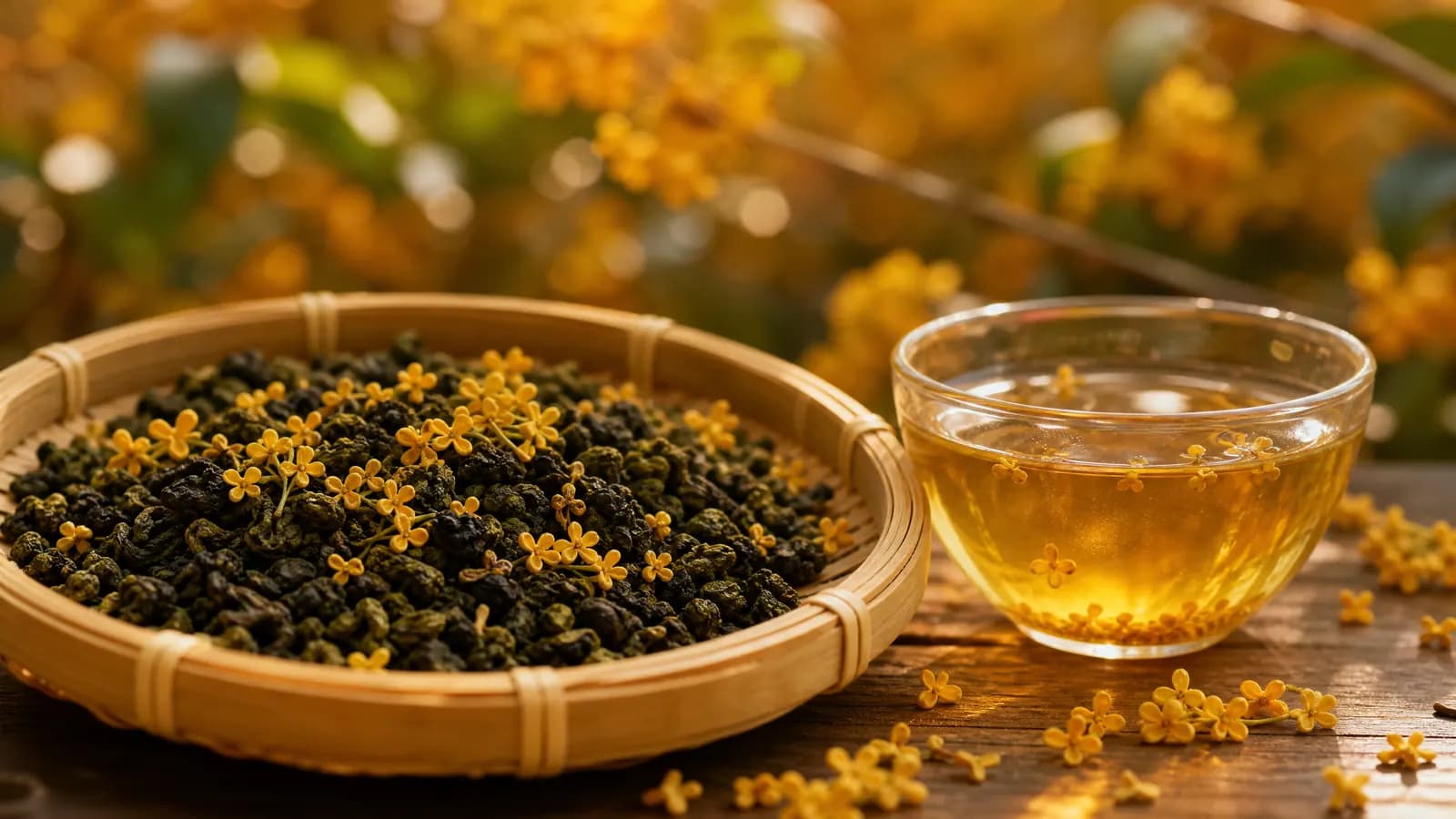
"Osmanthus oolong" sounds like one tea, but the label covers two quite different things, and tea lovers often mix them up.
Type 1: scented osmanthus oolong (桂花乌龙)
This is a scented tea. The maker takes a finished or nearly finished oolong and layers it with fresh osmanthus blossoms (Osmanthus fragrans, 桂花), so the leaf absorbs their apricot-like perfume. The Chinese word for this process is 窨制 (yìn zhì), the same technique used for jasmine tea.
China treats this as its own product category. The supply-and-marketing industry standard GH/T 1117 《桂花茶》 (Osmanthus tea) covers tea made by scenting green, black or oolong tea with fresh osmanthus flowers. The current 2022 edition, in force since March 2023, includes a specific osmanthus oolong sub-type and adds osmanthus white tea.
What to expect:
- A clear osmanthus perfume (sweet, apricot, a little honeyed) on top of the oolong.
- Sometimes small dried flowers in the leaf, which is normal for this style.
- A base oolong that varies by maker; the standard doesn't fix one.
Type 2: osmanthus-aroma dancong (桂花香单丛)
This one is not scented. Phoenix Dancong oolongs from Chaozhou are sorted into aroma types named for the flower or fruit their natural scent recalls, and 桂花香 (osmanthus aroma) is one of the ten traditionally cited types (see What are the Phoenix Dancong aroma types?).
Chaozhou's dancong naming standard defines these aromas as natural floral or fruity aroma produced by the cultivar and traditional oolong processing. No blossoms are added at any stage.
What to expect:
- An osmanthus-like note that belongs to the tea itself, together with dancong's honeyed, lingering finish.
- No flowers in the leaf.
How to tell which one you have
| Scented osmanthus oolong | Osmanthus-aroma dancong | |
|---|---|---|
| Flowers used? | Yes, fresh osmanthus | No |
| Chinese name | 桂花乌龙 / 桂花茶 | 桂花香单丛 |
| Where the aroma comes from | Absorbed from the blossoms | The tea plant and oolong processing |
| Origin | Made in many regions | Chaozhou, Guangdong (Phoenix Dancong area) |
| Flower bits in the leaf | Often | Never |
| Classification in China | Scented tea (GH/T 1117) | Oolong (dancong) |
The simplest check is the label. If it says "dancong", "单丛" or "Phoenix", it is the natural-aroma type. If it just says "osmanthus oolong", or you can see little golden flowers, it is almost certainly scented.
Why it matters
Neither type is better than the other. Scented osmanthus oolong is generous and immediately fragrant, which is why it works so well in drinks. An osmanthus-aroma dancong is subtler and changes over several infusions, so it suits slow gongfu brewing.
Osmanthus and the Mid-Autumn Festival
Osmanthus blooms in early autumn, around the Mid-Autumn Festival on the 15th day of the 8th lunar month. In the festival's best-known legend, Wu Gang is condemned to chop forever at an osmanthus tree on the moon, and osmanthus wine is a traditional festival drink. That is why osmanthus teas feel especially seasonal in September and October.
Tasting it at D²
You'll find osmanthus oolong on our menu as a pure tea, cold-brewed or hot and as an Osmanthus Oolong Tea Latte. If you'd like to compare the two styles described here, ask at the counter. It's one of our favourite conversations.
Sources
- GH/T 1117-2015 《桂花茶》 record and scope, State Administration for Market Regulation standards database: std.samr.gov.cn
- GH/T 1117-2022 《桂花茶》, National Digital Library of Standards: ndls.org.cn
- 《凤凰单丛(枞)茶命名规则》 T/CZTTBZ 002—2021, Chaozhou: chaozhou.gov.cn (PDF)
- Shanghai Municipal Government, "Mid-Autumn Festival" (English): english.shanghai.gov.cn