What Are the Phoenix Dancong Aroma Types?
Short answer
Phoenix Dancong oolongs are traditionally sorted into ten aroma types, named for the flower or fruit each tea's natural scent recalls: gardenia, orchid, magnolia, honey orchid, almond, ginger flower, cinnamon, osmanthus, tuberose and jasmine. No flowers are added; the aroma comes from the tea plant and the way it is made. The list is also open, and other aromas are recognised too.
By D² Tea Lab, Burnaby · Updated
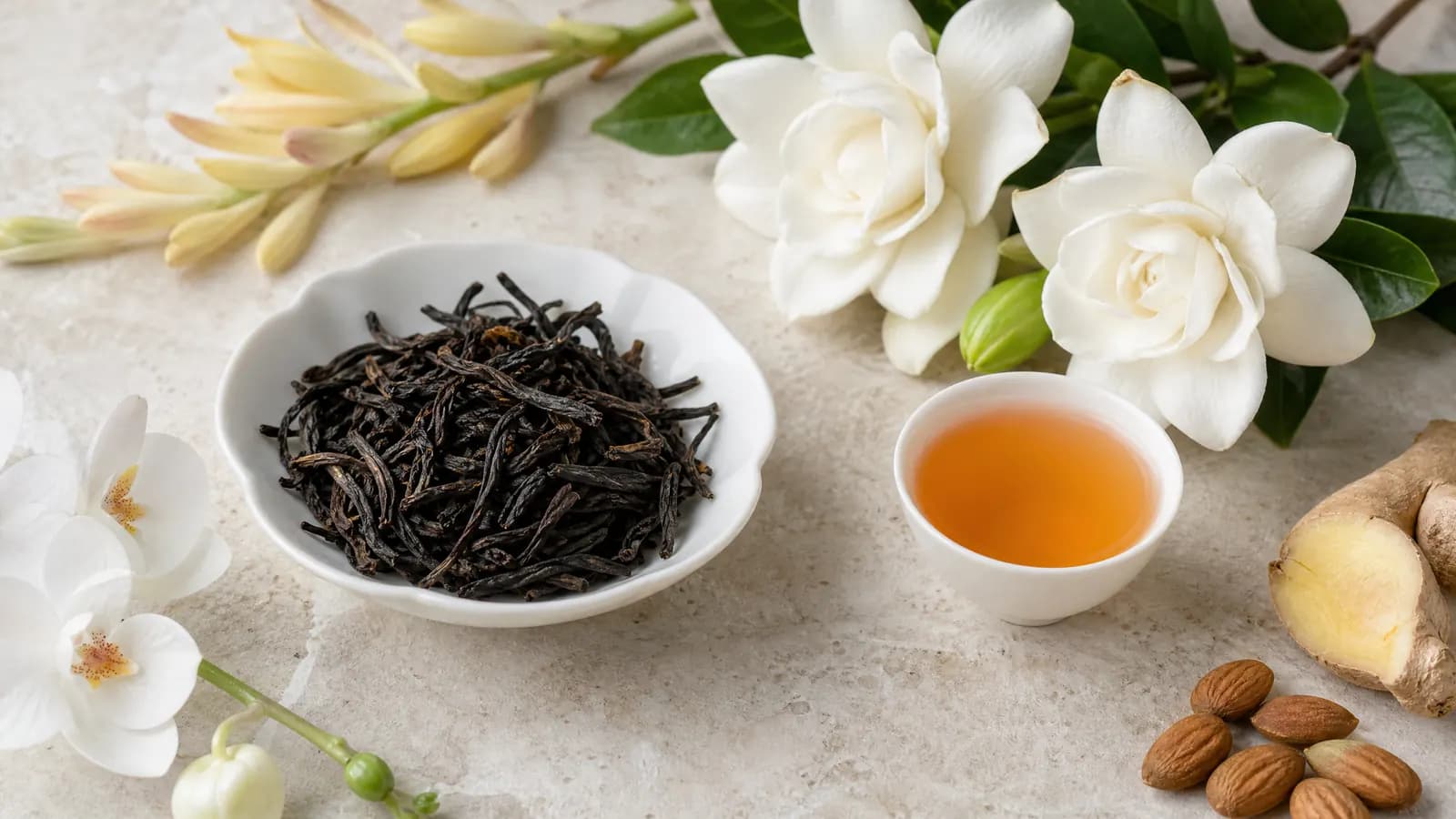
Phoenix Dancong (凤凰单丛, fènghuáng dāncōng) is an oolong from Phoenix Mountain in Chaozhou, eastern Guangdong. Aroma is what sets it apart: a dancong is usually named for the scent it brings to mind rather than its colour or shape, and Chaozhou has a traditional vocabulary for those scents.
The ten traditionally cited aroma types
A 2021 naming standard from Chaozhou's tea associations, proposed by the city's market regulator, lists ten aroma types (香型) and then adds "and other aroma types":
| Chinese | Pinyin | Usually translated as |
|---|---|---|
| 黄栀香 | huáng zhī xiāng | Gardenia |
| 芝兰香 | zhī lán xiāng | Orchid |
| 玉兰香 | yù lán xiāng | Magnolia |
| 蜜兰香 | mì lán xiāng | Honey orchid |
| 杏仁香 | xìng rén xiāng | Almond |
| 姜花香 | jiāng huā xiāng | Ginger flower |
| 肉桂香 | ròu guì xiāng | Cinnamon |
| 桂花香 | guì huā xiāng | Osmanthus |
| 夜来香 | yè lái xiāng | Tuberose / night-blooming flower |
| 茉莉香 | mò lì xiāng | Jasmine |
You may also see 黄枝香 for gardenia, a common variant spelling of the same name. Writers associated with the China Tea Science Society list further aromas beyond the ten, such as pomelo blossom (柚花香), orange blossom (橙花香) and bayberry (杨梅香).
What an "aroma type" means
The Chaozhou standard defines an aroma type as a group of cultivars or lines selected from the local Fenghuang Shuixian (凤凰水仙) tea variety, made by traditional oolong processing, that share a natural floral or fruity aroma, along with the lingering, honeyed character Chaozhou drinkers call cóng yùn (丛韵) and mì yùn (蜜韵).
Two things follow from that:
- Nothing is added. A "jasmine-aroma" dancong contains no jasmine and an "osmanthus-aroma" dancong contains no osmanthus. That is the main difference between a dancong and a scented tea. (See Is osmanthus oolong a scented tea or a dancong aroma?)
- The aroma depends on the plant and the processing together. The long shaking-and-resting stage of oolong making (做青) is where much of the fragrance develops.
How dancong teas get their names
The same standard allows four ways of naming a dancong:
- A heritage cultivar name, such as 棕蓑挟.
- An aroma type, such as 黄栀香 (gardenia).
- A compound name: a place, leaf shape, tree form or story plus an aroma type, such as 宋种黄栀香 ("Song-dynasty tree, gardenia aroma") or 八仙芝兰香 ("Eight Immortals, orchid aroma").
- A popular name that has stuck, such as 东方红, 岭头白叶 or the famous 鸭屎香. (See Why is it called "duck shit" tea?)
So when a shop sells "Mi Lan Xiang" or "Ba Xian", the name tells you which family of aromas to expect; it is not a brand.
Are the aroma types precise?
Not entirely. A 2015 study from Hanshan Normal University in Chaozhou, published in Food Science, noted that there is no national sensory standard for grading Phoenix tea aromas, so typing them is partly subjective and the boundaries blur. The same study did find measurable chemical differences between, for example, gardenia-type and cinnamon-type teas. So the categories are real, but two tasters may not always agree where one ends and the next begins.
What "dancong" means
单丛 literally means "single bush". Historically it was a quality grade: leaves picked and processed bush by bush. Over time it came to mean a cultivar line or simply a trade name. Most dancong sold today is not from one individual tree, even though the name suggests it.
Where it's grown
Phoenix Dancong is a protected geographical indication product in China, approved in 2010. Chaozhou's current rules (2025) define the protected area as 30 towns and tea districts across Chao'an District, Raoping County and Xiangqiao District, with Fenghuang town first on the list, and require the leaf to be grown and processed inside that zone. China also has a national product standard for dancong oolong, GB/T 30357.6-2017.
Tasting it at D²
Our Phoenix Oolong Lemon Tea is built on a dancong oolong, which is why it smells floral before you taste any lemon. If you're curious which aroma you prefer, the easiest way to learn is to compare two dancongs side by side. Honey orchid and almond are a good first pair because they are so different.
Sources
- 《凤凰单丛(枞)茶命名规则》 T/CZTTBZ 002—2021 (Naming rule of Fenghuang Dancong tea), Chaozhou, issued 2021-11-11: chaozhou.gov.cn (PDF)
- China Tea Science Society article by 陈少平 on dancong aroma types (2021): thepaper.cn
- Zhou Chunjuan et al., comparison of aroma compounds in different Fenghuang Dancong aroma types, Food Science (食品科学) 2015, 36(18): sciengine.com (PDF)
- Chaozhou government, Fenghuang Dancong geographical indication protection rules (潮府规〔2025〕3号): chaozhou.gov.cn
- GB/T 30357.6-2017 Oolong tea — Part 6: Dancong: chinesestandard.net