What Is Baiya Qilan, and Is It the Same as Wuyi Qilan?
Short answer
Baiya Qilan (白芽奇兰, "white-bud rare orchid") is an oolong tea cultivar selected in Pinghe County, southern Fujian, known for an orchid-like aroma; it has its own Chinese national standard, GB/T 30357.9-2020. "Wuyi Qilan" usually refers to Qilan bushes (mostly the same Baiya Qilan cultivar, introduced from Pinghe in the 1990s) grown in the Wuyi Mountains and made as rock oolong. The plant is the same; the place and the processing differ.
By D² Tea Lab, Burnaby · Updated
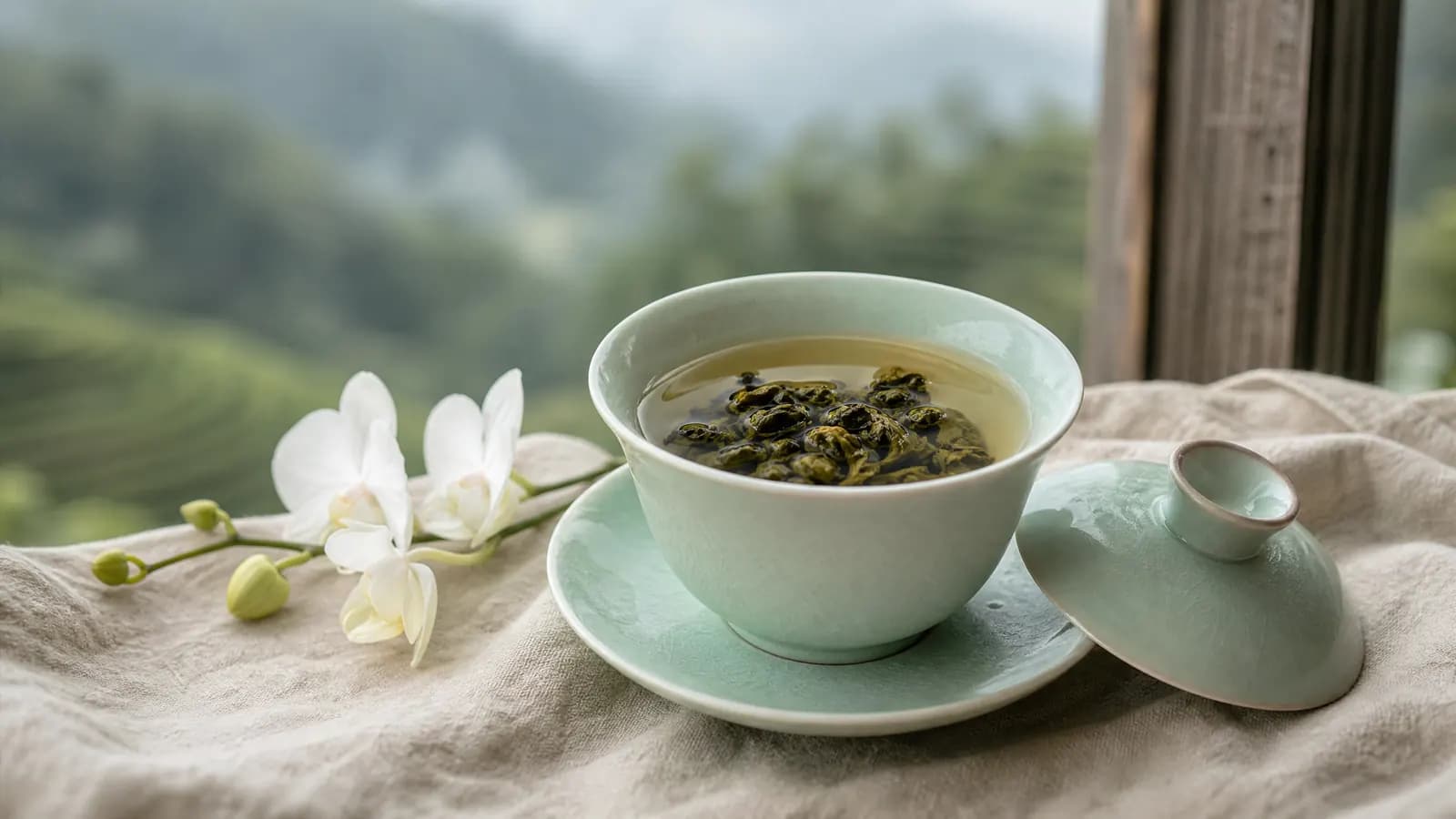
Baiya Qilan is one of the least documented oolongs in English. Even English Wikipedia's "Qilan tea" page describes Qilan only as a Wuyi oolong and never mentions Pinghe, where the cultivar comes from, so this article relies on Chinese sources.
The name
白芽奇兰 (bái yá qí lán) means roughly "white bud, rare orchid". The "white bud" refers to the pale, downy new shoots of the bush; "rare orchid" to the aroma, which Chinese descriptions consistently compare to orchids (兰花香). A local legend dates the name to the Qianlong era in Pengxi village, but no record confirms it.
Where it comes from
Baiya Qilan is from Pinghe County (平和县) in Zhangzhou, southern Fujian. This is the Minnan oolong region, not far from Anxi, home of Tieguanyin.
- It was selected between 1981 and 1995 from the local tea population by single-plant selection, credited to the Pinghe County agriculture bureau's tea station and the Pengxi tea farm in Qiling Township.
- It was approved as a Fujian provincial cultivar in 1996 (闽审茶1996001). Botanically it is described as a shrub with medium-sized leaves that buds late.
- Pinghe calls itself China's "hometown of tea (Baiya Qilan)", and "平和白芽奇兰" is protected as a geographical-indication certification trademark. A 2014 report noted it was also registered in Taiwan, the first Fujian tea certification mark registered there.
- The processing craft is on Zhangzhou city's list of intangible cultural heritage, and Fuzhou Daily reported in 2019 that the regional brand was valued at about ¥2.58 billion.
The national standard
Baiya Qilan has its own Chinese national standard: GB/T 30357.9-2020, Oolong tea — Part 9: Baiya Qilan (乌龙茶 第9部分:白芽奇兰), in force since April 2021. It covers oolong made from the Baiya Qilan cultivar and recognises two shapes:
- Granular (颗粒形): tightly rolled, like Tieguanyin
- Strip (条形): long twisted leaves, like Wuyi or dancong oolongs
There is also a tea industry group standard on brewing and tasting Baiya Qilan (T/CSTEA 00001—2018), drafted with the Pinghe agriculture bureau and the Pinghe Baiya Qilan Tea Association.
How it's made
Baiya Qilan is made as a southern Fujian oolong: the leaf is sun-withered (晒青), then repeatedly tossed and rested (做青) so the edges oxidise and the aroma develops, then fixed, rolled and dried, much as Tieguanyin is. Producers roast it more or less heavily, but we haven't found an authoritative classification of roast styles for Baiya Qilan, so we don't offer one.
So what is "Wuyi Qilan"?
Most of the confusion comes from this name.
- Qilan bushes were brought to the Wuyi Mountains from Pinghe in the 1990s, according to Chinese tea writing, and are now counted among Wuyi's "famous bush" (名丛) teas.
- The Qilan grown in Wuyishan is mostly the Baiya Qilan cultivar, with some Jinmian Qilan (金面奇兰) and other Qilan lines.
- In Wuyishan it is made as rock tea (yancha): strip-shaped and usually charcoal-roasted, so it tastes toastier and more mineral than a light Pinghe Baiya Qilan.
So Wuyi Qilan is largely the same plant, grown in a different place and made in a different style. What separates the two is terroir and processing rather than species. (For what makes Wuyi tea distinctive, see What is yan yun?)
Baiya Qilan vs Wuyi Qilan at a glance
| Baiya Qilan (Pinghe) | Wuyi Qilan | |
|---|---|---|
| Where grown | Pinghe County, southern Fujian | Wuyi Mountains, northern Fujian |
| Plant | Baiya Qilan cultivar | Mostly Baiya Qilan, plus other Qilan lines |
| Shape | Granular (rolled) or strip | Strip |
| Style | Southern Fujian oolong | Wuyi rock tea, usually roasted |
| Typical character | Orchid aroma, bright and floral | Orchid notes under roast and minerality |
| Standard | GB/T 30357.9-2020 | Covered as Wuyi rock tea (GB/T 18745) |
Tasting it at D²
Our Rock Oolong Tea Latte is made with Baiya Qilan oolong and fresh milk. If you've enjoyed it, try Baiya Qilan on its own, hot, in short infusions. The orchid aroma is much easier to find without milk.
Sources
- GB/T 30357.9-2020 Oolong tea — Part 9: Baiya Qilan, SAMR national standards platform: std.samr.gov.cn; preview: chinesestandard.net
- T/CSTEA 00001—2018 《白芽奇兰冲泡与品鉴》: ttbz.org.cn (PDF)
- Fuzhou Daily (福州新闻网) on Pinghe Baiya Qilan, 2019-12-13: fznews.com.cn
- On the Pinghe Baiya Qilan certification trademark registered in Taiwan (2014): ciplawyer.cn
- Cultivar history and Wuyi Qilan: 3ctea.com, sohu.com
- English Wikipedia, "Qilan tea" (for comparison; it omits Pinghe): wikipedia.org