What Is Yan Yun ("Rock Rhyme") in Wuyi Oolong?
Short answer
Yan yun (岩韵, "rock rhyme" or "rock charm") is the character Chinese tea drinkers prize in Wuyi rock oolong, a mineral, full, long-lasting quality often summed up as "rock bone, floral fragrance" (岩骨花香). China's rock tea standard ties it to tea grown in Wuyishan, and growers rank it strongest in tea from the core rocky gorges (zhengyan), weaker on the edges (banyan) and riverside flats (zhoucha).
By D² Tea Lab, Burnaby · Updated
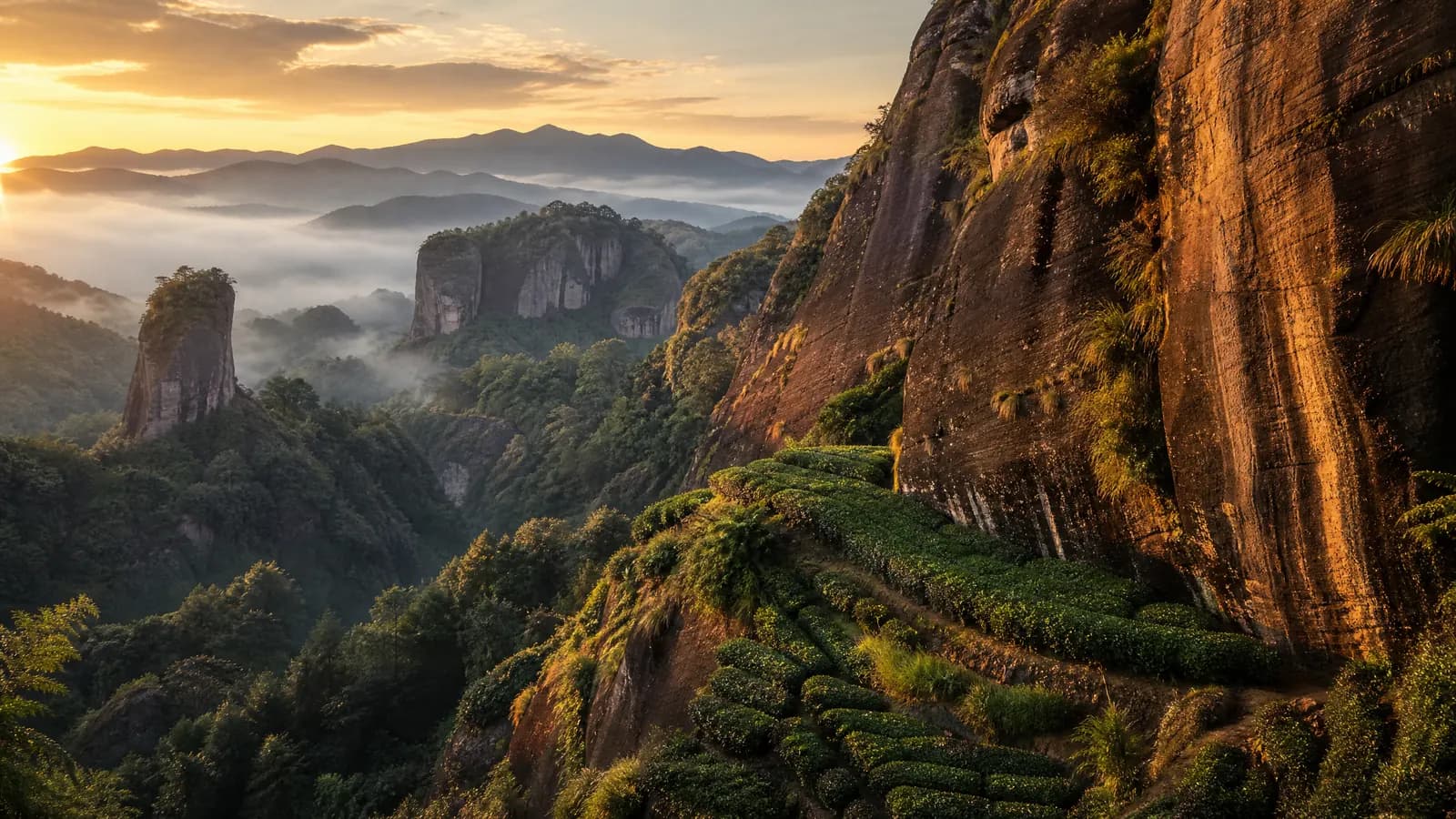
Ask a Wuyi tea maker what makes their tea special and you'll hear two words: yán yùn. It's the reason rock oolong exists as a category, and the reason two Da Hong Paos at very different prices can look identical.
What the words mean
- 岩 (yán): rock, cliff
- 韵 (yùn): rhyme, charm, resonance; in tea, a lingering character that stays after you swallow
So yan yun is the "rock charm" of tea grown among Wuyi's cliffs. Drinkers describe it as a mineral, almost stony depth, a full body, and a finish that lasts and returns as sweetness. The classic four-character phrase is 岩骨花香, "rock bone, floral fragrance": the structure of the rock and the perfume of the flower in one cup.
Yan yun is a sensory idea rather than a lab measurement. Experienced drinkers recognise it; new drinkers often notice it first as "this tastes like more than roast".
Yan yun in the national standard
China's Wuyi rock tea standard ties the concept to place. According to reporting on the revised GB/T 18745-2026 (in force from April 2027), Wuyi rock tea is defined as tea produced within the administrative area of Wuyishan City, Fujian, with yan yun, "rock bone, floral fragrance". The current 2006 edition remains in force until then.
The growing zones
Wuyi tea is traditionally graded by where in the mountains it grows:
| Zone | Chinese | Where | Reputation |
|---|---|---|---|
| Core rock | 正岩 zhèng yán | The rocky gorges and cliffs at the heart of the scenic area | Strongest yan yun, most prized |
| Half rock | 半岩 bàn yán | The edges of the core area | In between |
| Riverside flats | 洲茶 zhōu chá | Flat land along the streams | Lighter, less yan yun |
| Outer mountains | 外山 wài shān | Outside the traditional area | A popular fourth tier, not an official one |
People's Daily describes 正岩, 半岩 and 洲茶 as the standard three-way division. The fourth, 外山茶, is common in the trade but isn't a formal classification.
"Three pits and two streams"
Within the core area, the most famous gorges are known as 三坑两涧, "three pits, two streams". The list most often given:
- 牛栏坑 Niulankeng
- 慧苑坑 Huiyuankeng
- 大坑口 Dakengkou
- 流香涧 Liuxiangjian
- 悟源涧 Wuyuanjian
Some sources add a sixth, 倒水坑 Daoshuikeng. There's no official definition, so you'll see the list vary. Tea labelled with one of these names commands a premium, and because the names are valuable, it is worth buying from sellers you trust.
Does location really change the tea?
Research has found measurable differences:
- A 2016 review by 陈华葵 and 杨江帆 in the Journal of Food Safety and Quality found quality generally ranks core rock above half rock above riverside tea, and attributes the differences to microclimate, soil and geology.
- People's Daily reported in 2024 that a Fujian Agriculture and Forestry University team led by Professor Liao Hong analysed more than 10,000 tea and soil samples and found significant differences in the teas' metabolites between the three zones.
Yan yun is still not a single chemical, but the old growers' grading by place does reflect real differences in the leaf.
Is yan yun the same as roast?
No, though the two are often confused. Wuyi oolongs are usually charcoal-roasted, and roast adds toasty, caramel and smoky notes. Yan yun is the character of the leaf underneath. A heavy roast can hide a lack of it, which is why experienced drinkers often prefer to judge rock tea at a lighter roast. The new standard's requirement that labels state the roast level (light, medium or full fire) helps buyers tell them apart. (See What is Da Hong Pao today?)
Tasting it at D²
Our Roasted Oolong Tea Latte uses Da Hong Pao, a Wuyi rock tea. In milk you'll mostly notice the roast; brewed on its own in short infusions, you can start to look for the long, mineral finish that tea drinkers call yan yun.
Sources
- People's Daily, on the Wuyi growing zones and Prof. Liao Hong's research, 2024-03-20: people.com.cn
- 陈华葵、杨江帆, 《武夷岩茶不同岩区品质形成研究进展》, Journal of Food Safety and Quality 7(1):257–262, 2016: catalogue record
- Minbei Daily via People's Daily app, on the GB/T 18745-2026 definition of Wuyi rock tea, 2026-08-06: peopleapp.com
- GB/T 18745, SAMR national standards platform: std.samr.gov.cn
- Jiemian, on Wuyi zones and the "three pits, two streams": jiemian.com, jiemian.com