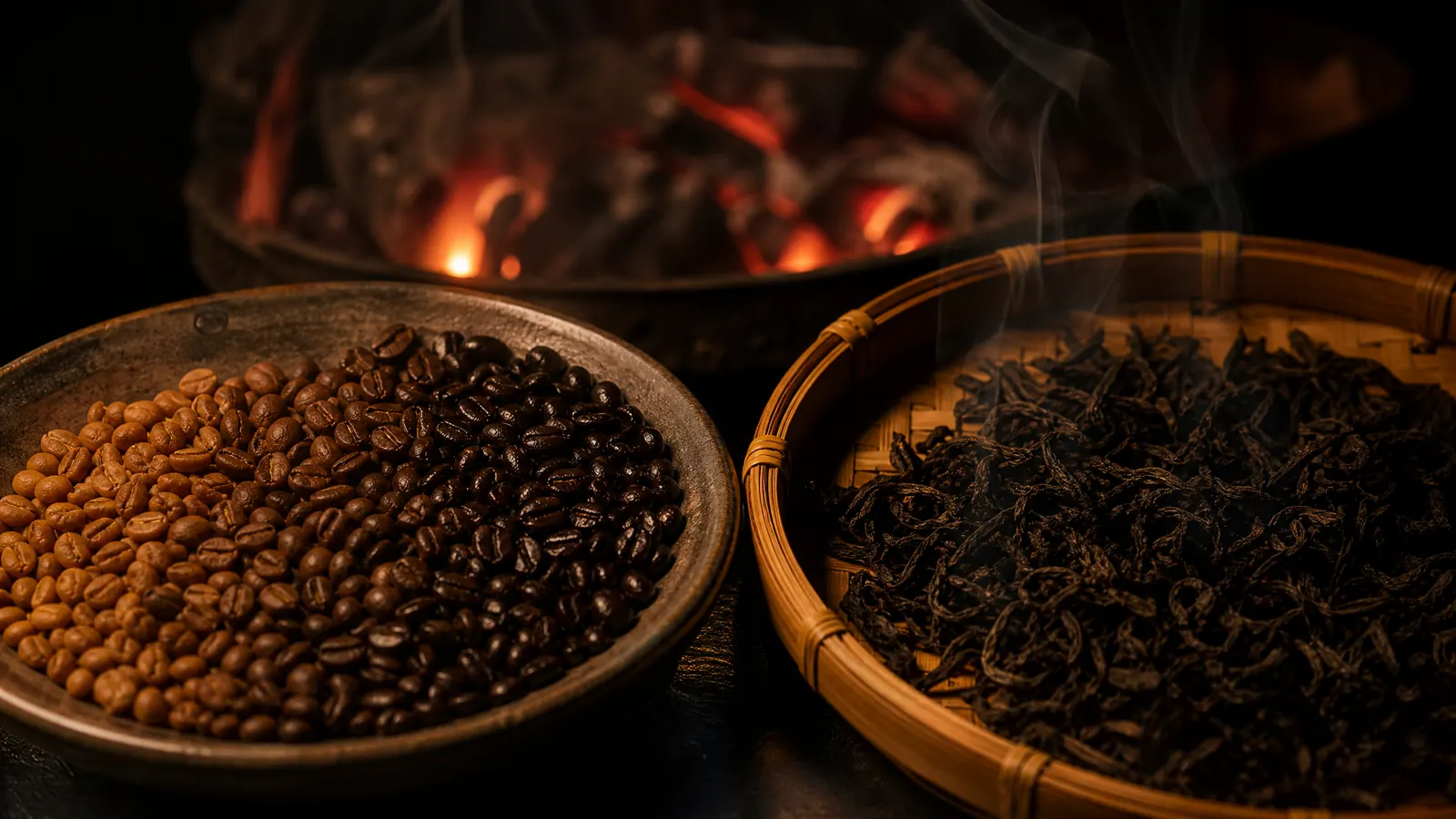
A green coffee bean tastes nothing like coffee. It's grassy, beany and hard enough to chip a tooth. A freshly made oolong leaf, before its final roast, is lighter and more floral than the tea you know. In both cases, controlled heat is what turns the raw material into the flavour you love.
At D² Tea Lab we work with roasted tea every day. Our Roasted Oolong Tea Latte is built on Da Hong Pao, a roasted oolong from the Wuyi Mountains, and as we test coffee we keep noticing how much the two crafts share.
What heat does to a coffee bean
Roasting coffee takes minutes, and a lot happens in them.
- Drying. The beans lose moisture and turn from green to yellow, smelling of hay and bread.
- Browning. Sugars and amino acids react in the Maillard reaction (the same chemistry that browns toast and seared steak), creating hundreds of aroma compounds. Sugars also begin to caramelise.
- First crack. Steam and gas build up inside the bean until it audibly pops, a little like popcorn. Coffee taken off the heat soon after this is a light roast.
- Development. Keep going and acidity softens while sweetness and body build. This is a medium roast.
- Second crack. The bean's structure starts to break down, oils rise to the surface and roasty, bitter, smoky flavours take over. This is a dark roast.
Each step trades something away. Light roasts keep the bean's origin character: the fruit, the flowers, the acidity. Dark roasts swap those for body and roast flavour. Which is better depends on what you want in the cup.
What heat does to a tea leaf
Oolong is made by withering, gently bruising and partially oxidising fresh tea leaves, then fixing them with heat. Many oolongs stop there and stay green and floral. Others go on to be roasted. This is especially true of the rock teas of the Wuyi Mountains in Fujian, like Da Hong Pao, which are traditionally roasted over charcoal, sometimes in several rounds with rests in between.
Tea makers talk about roast level in a way a coffee roaster would recognise:
| Roast | In coffee | In Wuyi oolong |
|---|---|---|
| Light | Bright, fruity, floral | Fragrant, floral, lighter colour |
| Medium | Caramel, nuts, balanced | Toasty, honeyed, stone-fruit |
| Heavy | Dark chocolate, smoky, bitter edge | Deep roast, cocoa, charcoal warmth |
Roasting tea also drives off moisture and softens grassy notes, and roasted oolongs are prized for a warm, lingering finish. Tea drinkers in Wuyi have a word for the mineral, long-lasting character of their best rock teas: yán yùn, often translated as "rock rhyme".
The same trade-offs
Whether it's a bean or a leaf, the roaster is balancing the same things:
- Origin vs. roast: every minute of roast adds roast flavour and takes away a little of what the plant brought with it.
- Sweetness vs. bitterness: browning creates sweetness, but push too far and it tips into bitterness and ash.
- Aroma vs. body: lighter roasts smell more complex, and darker roasts feel heavier.
This is why roasted oolong and medium-to-dark coffee both pair well with milk. Their body and roasty sweetness carry through the dairy, where a delicate green tea or a very light coffee can get lost.
What we're doing with it
When we built our roasted oolong latte, we chose a tea with enough roast to hold its own against milk at our three-to-seven ratio, without the bitterness of an over-fired leaf. Testing coffee, we're asking the same question in reverse: which roast levels stay sweet and clear with milk, and which are best enjoyed black?
If you like our roasted oolong latte, there's a good chance you'll enjoy a medium-roast coffee with milk, and the other way round. Come by and compare.
Frequently asked questions
Does roasting reduce caffeine in coffee? Only slightly. Caffeine is fairly stable at roasting temperatures. Differences you notice between roasts come from how much coffee is used, not the roast level itself.
Is roasted oolong the same as black tea? No. Black tea is fully oxidised. Roasted oolong is partially oxidised and then roasted, which gives a toasty flavour while keeping some of oolong's floral character.
What is Da Hong Pao? One of the most famous Wuyi rock oolongs from Fujian, China, known for its roasted, mineral character. It's the tea behind our Roasted Oolong Tea Latte.