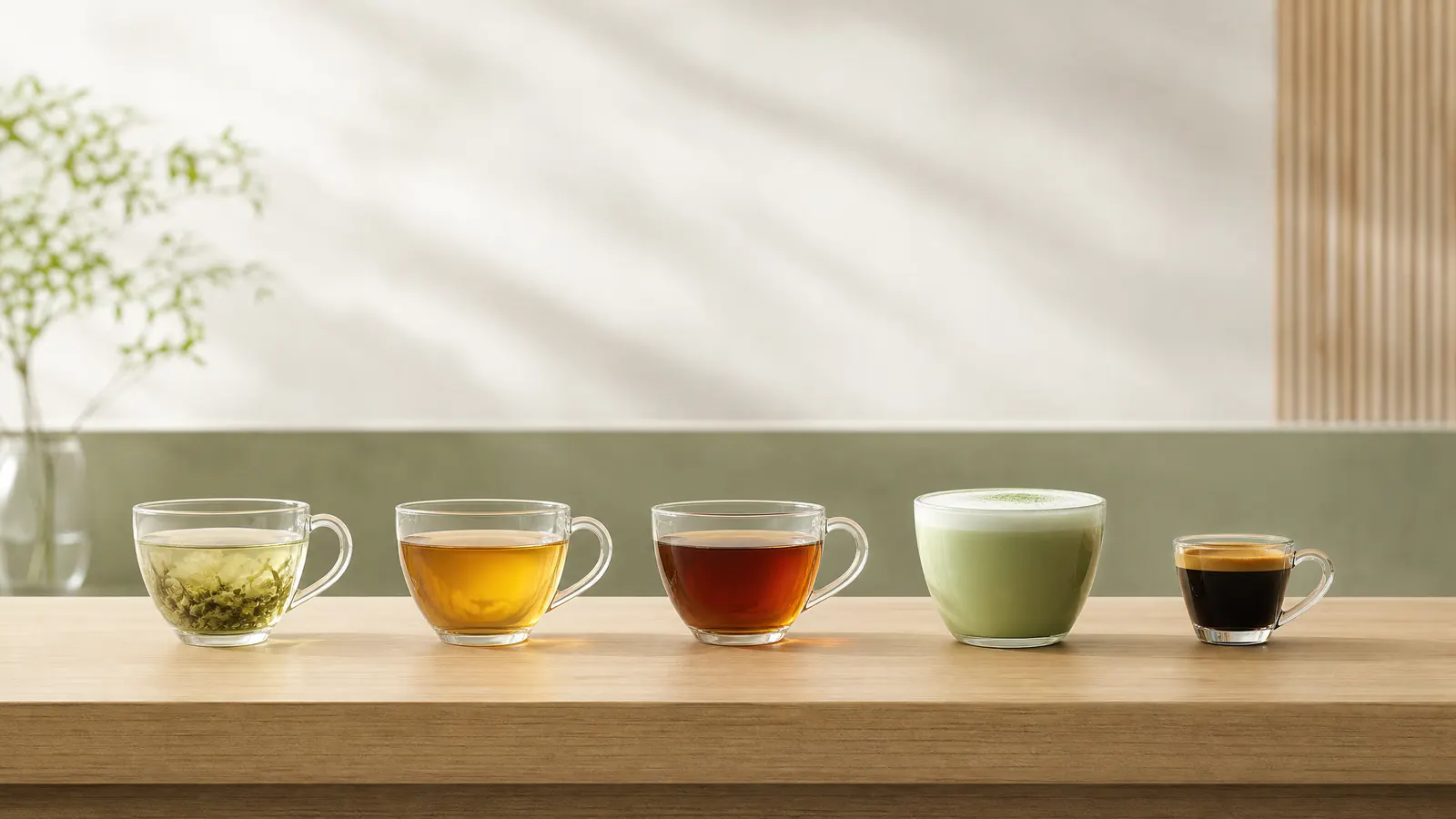
"Is a tea latte gentler than coffee?" is one of the questions we hear most. Usually, yes, but how big the gap is depends on the tea, how it's brewed and how big the cup is.
Approximate caffeine per serving
Caffeine varies widely from cup to cup. These are typical reference figures, rounded:
| Drink | Typical serving | Approx. caffeine |
|---|---|---|
| Brewed coffee | 240 ml (8 oz) | about 95 mg |
| Espresso | 1 shot, 30 ml | about 65 mg |
| Matcha | per gram of powder | roughly 20 to 45 mg per gram |
| Black tea, brewed | 240 ml | about 45 mg |
| Oolong tea, brewed | 240 ml | about 35 to 40 mg |
| Green tea, brewed | 240 ml | about 30 mg |
Sources: USDA FoodData Central reference values for brewed coffee, espresso, and brewed black and green tea; matcha and oolong figures vary more by product and are given as ranges. Individual drinks can be well above or below these numbers.
Health Canada suggests healthy adults limit caffeine to up to 400 mg a day, with lower limits for some groups. See Health Canada's guidance on caffeine for details.
Why tea varies so much
A cup of tea can contain half the caffeine of another cup of the same tea. The main reasons:
- How much leaf: more leaf means more caffeine. A milk tea brewed strong enough to taste through the milk uses more leaf than a light cup.
- Water temperature: hotter water pulls caffeine out faster.
- Steeping time: the longer it steeps, the more caffeine ends up in the cup.
- The leaf itself: young buds and leaves tend to carry more caffeine than older leaves. Shade-grown teas like matcha are higher too.
- Whole leaf or powder: with brewed tea you drink an infusion and throw the leaves away. With matcha you drink the whole ground leaf, so you get all of its caffeine.
That last point surprises people. A matcha latte can come close to a coffee, depending on how many grams go in.
Why coffee varies too
Coffee isn't constant either. The amount of ground coffee, the brew method and the cup size matter far more than roast colour, and a large drip coffee can contain more caffeine than a double espresso. A latte has exactly the caffeine of the espresso in it. The milk adds volume but no caffeine.
Where a tea latte fits
Cup for cup:
- Most brewed tea lattes (black tea, oolong, jasmine green) land below a typical coffee.
- Matcha lattes can be similar to coffee, depending on the dose.
- Espresso drinks vary with the number of shots.
A note on how caffeine feels
Many tea drinkers say tea "feels different" from coffee. Tea also contains L-theanine, an amino acid found almost only in tea plants, and researchers continue to study how it and caffeine interact. We'll leave the science to the scientists. What we can say is that the amount of caffeine is only part of how a drink is experienced, and everyone responds differently.
Choosing your cup
If you're watching caffeine, ask how a drink is made: how much tea or coffee goes in, and how many shots. Choosing a smaller size, a green or oolong tea, or a drink with less concentrate all make a difference. If you're sensitive to caffeine, it's worth checking with a healthcare professional what's right for you.
As we add coffee alongside our teas at D² Tea Lab, we'll make it easy to tell what's in each cup.
Frequently asked questions
Does a latte have more caffeine than brewed coffee? Not necessarily. A latte's caffeine comes entirely from its espresso. A single-shot latte typically has less caffeine than a large brewed coffee.
Does milk reduce caffeine? No. Milk dilutes the flavour and adds volume, but the caffeine in the cup stays the same.
Is matcha higher in caffeine than other teas? Usually, because you drink the whole powdered leaf rather than an infusion. The total depends on how many grams are used.
Is there caffeine in jasmine tea? Yes. Jasmine tea is usually made from green tea, so it contains caffeine, typically less than coffee.